

People are now asking, “which is easy cybersecurity or artificial intelligence? “as many professionals are assessing their careers in the fast-changing technology world. It may be safe to say that neither of these fields is “easy” in any sense.
A person’s difficulty in a field will also depend on the field. That is, one’s background, learning type, or career goals can also determine one’s outcome. Based on the latest info on the job market and industry trends, I will deconstruct the complicated nature of the job field and the industry, which will help you make an informed decision after consideration.
Which is Easy Cybersecurity or Artificial Intelligence?
Neither cybersecurity nor AI is easier than the other; they can not even be compared. Both domains require a great deal of technical skills and learning. However, cybersecurity typically offers more accessible entry points, with 90% of hiring managers considering candidates with only IT experience, while AI positions predominantly favor specialists, with only 2.5% targeting entry-level professionals.
Understanding What Each Field Actually Involves
Cybersecurity: The Digital Defense Network
Cybersecurity professionals are like the guards of the digital world who protect any organization from changing viral threats. When I started seriously researching in this area, I was impressed by how much is that here you do. Installing firewalls won’t matter if you don’t know how your opponent operates. You need to keep anticipating new hacks and building better systems.
Cybersecurity includes a lot of things. There is penetration testing, where you actually hack a system to find vulnerabilities. Then there is incident response, which is where you will manage a cybersecurity attack as it happens. Cybersecurity’s uniqueness is its proactive and reactive nature. You are always changing with the threats, so the work is never routine.
Current data shows that 67% of organizations worldwide report cybersecurity staff shortages, making this one of the most in-demand fields in tech. Over 440,000 cybersecurity positions were added globally with an 8.7% increase in the workforce in 2023, compared to 2022.
Artificial Intelligence: Building Tomorrow’s Technology
Professionals in AI are crossing the realms of computer science, mathematics, and creativity.
Taking a look at the job market trends lately, AI engineering has moved away from academia and is entering the commercial sector. AI professionals today build practical applications that fix real business problems, notably recommendation systems or chatbots that can detect and respond to human conversation naturally.
The field requires a deep understanding of machine learning algorithms, programming languages like Python (required in 71% of AI job postings), and statistical concepts. AI work often involves longer cycles and experimental work, unlike cybersecurity, which usually has immediate problem-solving goals.
Learning Curve Analysis: Entry Points and Skill Requirements
When assessing which is easy cybersecurity or artificial intelligence, a key consideration is the learning curve associated with either. The two fields require commitment and regular practice, but the process to get started can vary greatly. Unlike Cybersecurity, which gives you quicker access through certifications and labs, AI is more foundational. You need to study more math, programming, and research first before using it.
Cybersecurity’s Accessible Pathways
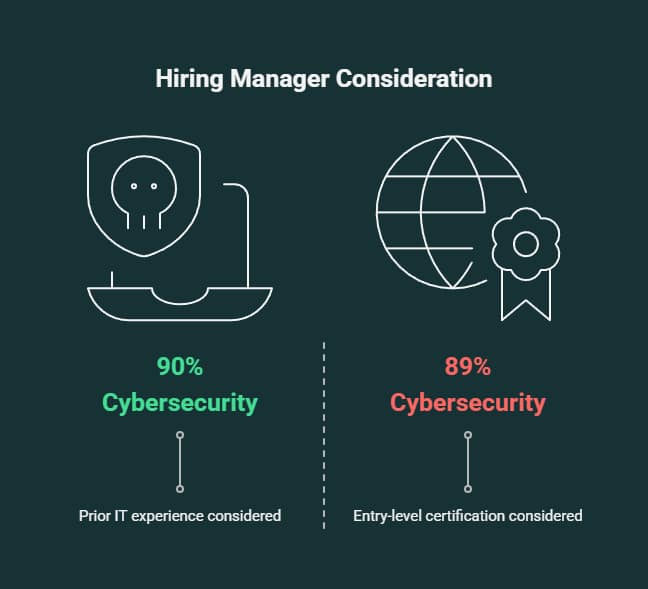
From the perspective of learning, which is easy cybersecurity or artificial intelligence? Cybersecurity entry points are easier. According to research, 90% of cybersecurity hiring managers would consider candidates with just prior IT work experience, while 89% would consider entry-level cybersecurity certification only.
Programming Requirements. Cybersecurity may not always require coding knowledge, although it’s important. Lots of roles with policy, compliance, risk assessment, and security administration require little or no coding knowledge.
Certification Pathways. Beginner certifications like CompTIA Security+ and ISC2’s Certified in Cybersecurity (CC) offer clear learning journeys. These certificates are for starters and do not need extensive prior experience.
Skills Emphasis. Current demand for hiring cybersecurity managers shows that technical knowledge is important, but so is non-technical knowledge. Three of the top five skills valued by hiring managers are teamwork, problem-solving, and analytical thinking—all transferable skills from other industries.
Artificial Intelligence’s Steeper Initial Climb
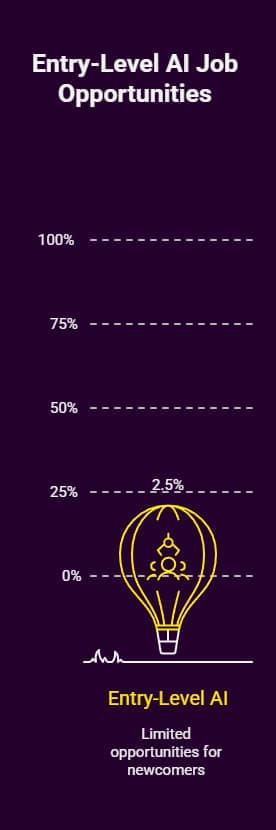
AI presents a more challenging initial learning curve. My examination of 1,000 job listings for AI experts shows only 2.5% of postings are meant for those just entering AI, or have 0-2 years of experience, meaning it is not easy to enter this field.
Mathematical Foundation. You need a good understanding of mathematics to learn AI. Machine learning heuristics work by utilizing these mathematical concepts in backpropagation.
Programming Intensity. It is almost essential to know Python (required in 71% of jobs) and its frameworks, like TensorFlow, PyTorch, etc. In cybersecurity, coding could be additional, but programming is like the main dish in AI.
Academic Requirements. While 48.6% of AI positions accept bachelor’s or master’s degrees, many still prefer advanced education. In 27.7% of job ads, PhD requirements are found, which shows that the sector is research-oriented.
Career Opportunities and Job Market Dynamics
Cybersecurity: Broad Industry Demand
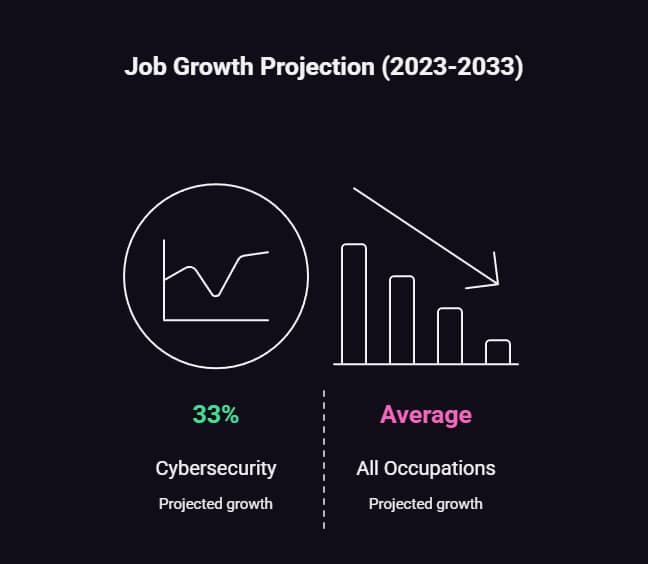
The cybersecurity job market is very stable and growing. The Bureau of Labor Statistics projects 33% growth for cybersecurity roles between 2023 and 2033—much faster than the average for all occupations.
Industry Breadth. Every industry needs cybersecurity professionals. Across all industries, organizations are hiring security specialists – healthcare, finance, government, and retail. This variety means more services and job versatility.
The average entry-level salary for jobs in cybersecurity in the US is roughly $96,490. Over time, the average cybersecurity salary can rise considerably as one gains more experience in the field.
reaching $124,452 per year.
Geographic Distribution. Some cities will provide you with more opportunities, but cybersecurity jobs are spread out better than AI jobs.
Artificial Intelligence: High-Reward, High-Competition
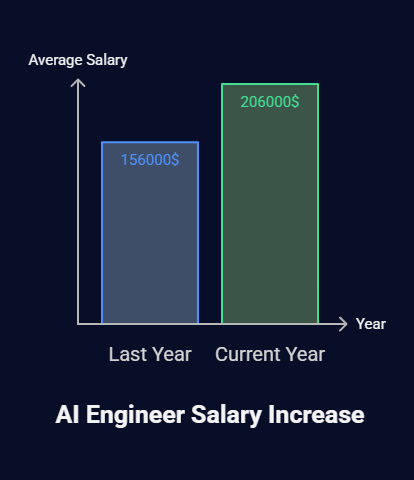
AI provides more concentrated avenues of earning potential. The average AI engineer salary.
has jumped to $206,000 — an impressive increase of $50,000 compared to last year.
Geographic Concentration. AI jobs are heavily concentrated, with 33% of positions located in California alone. This concentration may mean more competition in fewer places.
Specialization Premium. AI jobs often pay high salaries because of the specific skills. Yet, it can hinder the flexibility of changing jobs between companies or industries.
Industry Focus. As organizations in other sectors scramble to adopt AI, most job opportunities are still limited to tech firms, research houses, and large companies with active funding for AI programs.
Difficulty Levels: Entry to Advanced Practice
Cybersecurity’s Practical Learning Approach
When we talk about practical application, Cybersecurity is easier to learn than Artificial Intelligence. Cybersecurity offers the option of easy hands-on learning.
Entry-Level Tasks. New cybersecurity workers may engage in some of the most concrete tasks in the industry, including security monitoring, rudimentary incident response, and documentation to demonstrate compliance. These tasks create immediate value while building knowledge.
Learning by Doing. The field emphasizes practical experience. You can build up your skills by setting up home labs, capture-the-flag competitions, and vulnerable systems.
Clear Problem Definition. Cybersecurity issues are often binary in nature. Either a system is secure, or it isn’t. Either an incident did occur, or it didn’t. This neatness can help newcomers measure progress better.
Artificial Intelligence’s Abstract Complexity
AI work usually consists of solving problems that are more abstract and taking longer to respond.
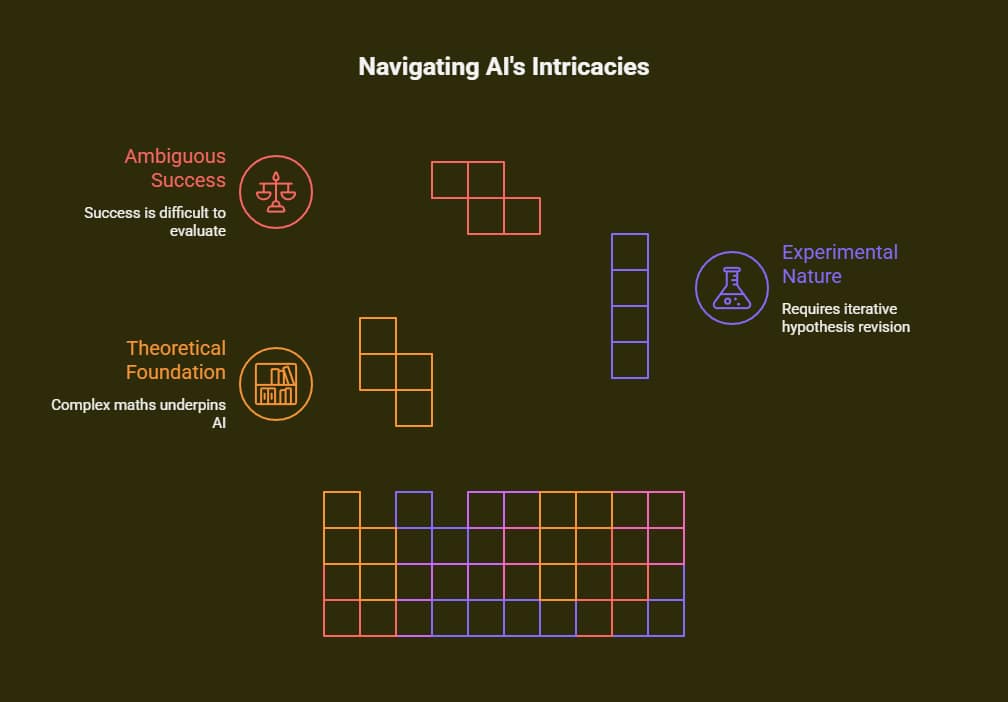
Theoretical Foundation
You need to understand complex maths before applying AI practically. Those who do not have a sound mathematical basis may struggle with this theory.
Experimental Nature
AI projects take a lot of experimenting, undertaking hypotheses, and revising. Results aren’t seen right away, so try and try again
Ambiguous Success Metrics
Unlike cybersecurity, which is either successful or not, the result of AI could be successful but still incorrect. A model may be “good enough” for one application but not another. Such subtleties need skills to evaluate.
Future Outlook and Industry Evolution
Cybersecurity’s Sustained Growth
The field of online security is very robust and expanding. The global cybersecurity market.
The valuation of this market was $197 billion in the year 2021, and it is expected to reach $657 billion by the year 2030.
Evolving Threat Landscape. As new technologies emerge, new security challenges follow. This ensures a steady and ever-growing demand for cybersecurity professionals.
AI Integration. AI is not replacing cybersecurity professionals; it’s becoming a tool to help them. 82% of cybersecurity professionals believe AI will improve their job efficiency.
Artificial Intelligence’s Explosive Potential
AI’s growth trajectory is extraordinary. The AI market is expected to reach $1.3 trillion by 2030, up from an estimated $214 billion in 2024.
Automation Impact. While many jobs will be automated with the introduction of AI, many jobs will also be created for people who program them.
Cross-Industry Integration. AI technology is becoming an integral part of business operations across industries. As a result, this is creating multiple career opportunities even outside traditional tech firms.
Personal Factors: Which Field Suits You Better
Background and Personality Considerations
What You Are Already Trained On, Cybersecurity Or Artificial Intelligence, Would Be Easy For You.
For Those With Business/Management Experience
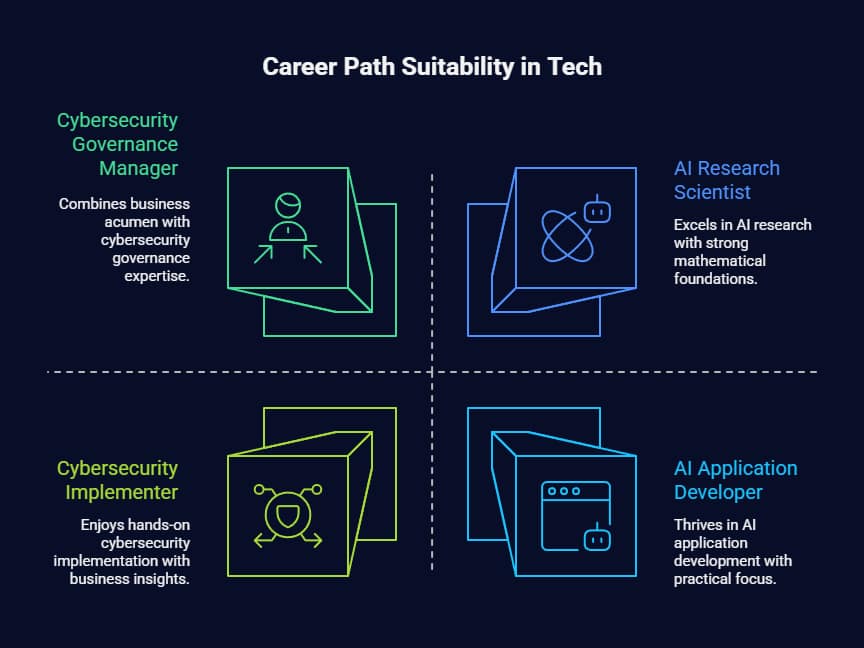
Cybersecurity governance, risk, and compliance roles combine business knowledge with technical expertise. The profession has different views that help communicate.
For Mathematical Minds
AI may feel more intuitive to you if you enjoyed calculus, statistics, and abstract reasoning. Those who are at ease with mathematical concepts and with experimental methods are well-rewarded in the field.
For Hands-On Learners
People like cybersecurity because it has practical problems and answers. You will see the direct impact of your security implementations.
For Research-Oriented Individuals
People who like working on things that are hypothesis-driven in nature, with iterative improvement and practicing what can be done, use AI.
Learning Style Alignment
Visual Learners. Cybersecurity provides network visualizations, threat maps, and security dashboards to gain a better understanding.
Analytical Learners. Many enjoy using the data-driven and mathematical nature of AI to break down complex problems into quantifiable parts.
Practical Learners. Cybersecurity is a hands-on field that gives you feedback from security tools and systems. If you’re a person who learns best by doing, this approach is for you.
Theoretical Learners. The research component in AI learning, where one reads a lot of papers, is appealing.
Comparison Table: Key Differences
Cybersecurity vs Artificial Intelligence
| Factor | Cybersecurity | Artificial Intelligence |
|---|---|---|
| Entry Barriers | Lower – around 90% of roles require only IT/networking experience. | Higher – only ~2.5% of jobs are entry-level. |
| Programming Needs | Optional for many roles (focus on tools and systems). | Mandatory – Python required in ~71% of AI-related jobs. |
| Math Requirements | Advanced degrees (Master’s/PhD) are preferred for many roles. | Advanced math (calculus, statistics, linear algebra) required. |
| Time to Independence | 4–9 months of training/certs can get you started. | 1–2 years to become effective in building and deploying models. |
| Average Salary (US) | ~$124,000 (good baseline). | $124,000 to $206,000 (higher ceiling). |
| Job Market | 457,000+ open positions in the U.S. (broad demand). | Concentrated in tech hubs and research-heavy companies. |
| Remote Work | ~33% working remotely today. | ~5.9% fully remote positions (lower flexibility). |
| Industry Spread | Needed across all industries (finance, healthcare, government, etc.). | Heavily concentrated in tech and research-oriented industries. |
| Education/Credentials | Entry-level certifications are highly valued (Security+, CEH, CISSP, etc.). | Advanced degrees (Master’s/PhD) preferred for many roles. |
| Skills Focus | Mix of technical and soft skills (problem-solving, security mindset). | Heavy technical + mathematical focus (data, algorithms, modeling). |
Making Your Decision: Neither is “Easy,” Both Are Rewarding
There are efforts to consider when looking into which is easy cybersecurity or artificial intelligence, but the field that is easier? They both require commitment and continuous learning, and much skill-building.
However, they offer different paths to success.
Choose Cybersecurity If
- You appreciate diversity and immediate solutions.
- You desire a wide variety of choices in the industry.
- I appreciate security and balanced employment.
- You may use already available business or IT experiences.
- You like to learn through doing.
Choose Artificial Intelligence If
- You have a strong sense for math and statistics.
- You enjoy work related to active experimentation.
- You are comfortable spending a lot of money on education and training.
- You are driven by advanced technology development.
- You can deal with geographic restrictions and fierce competition.
Both fields have great job opportunities and salary packages, along with meaningful contributions to society. The choice that is easy for you is dependent on your strengths and goals.
Keep in mind that many professionals successfully switch careers as their careers develop. Whether with technology or engineering, our problem-solving abilities, technical knowledge, and constant learning help of towards a better future.
If you want to know about two rewarding career choices, cybersecurity and artificial intelligence are popular. Both fields are evolving and need specialists who are ready to invest in their skills. Pick the one that suits your skills and choices. Focus on acquiring knowledge to keep up with the ever-changing demands of each field.
Neither cybersecurity nor artificial intelligence is an “easy” job, but they can both be rewarding careers if you are ready to take the challenge. It is not the question of which is easy cybersecurity or artificial intelligence, but rather which challenges are you most keen on.


