


Google Gemini and n8n work together for better workflows.
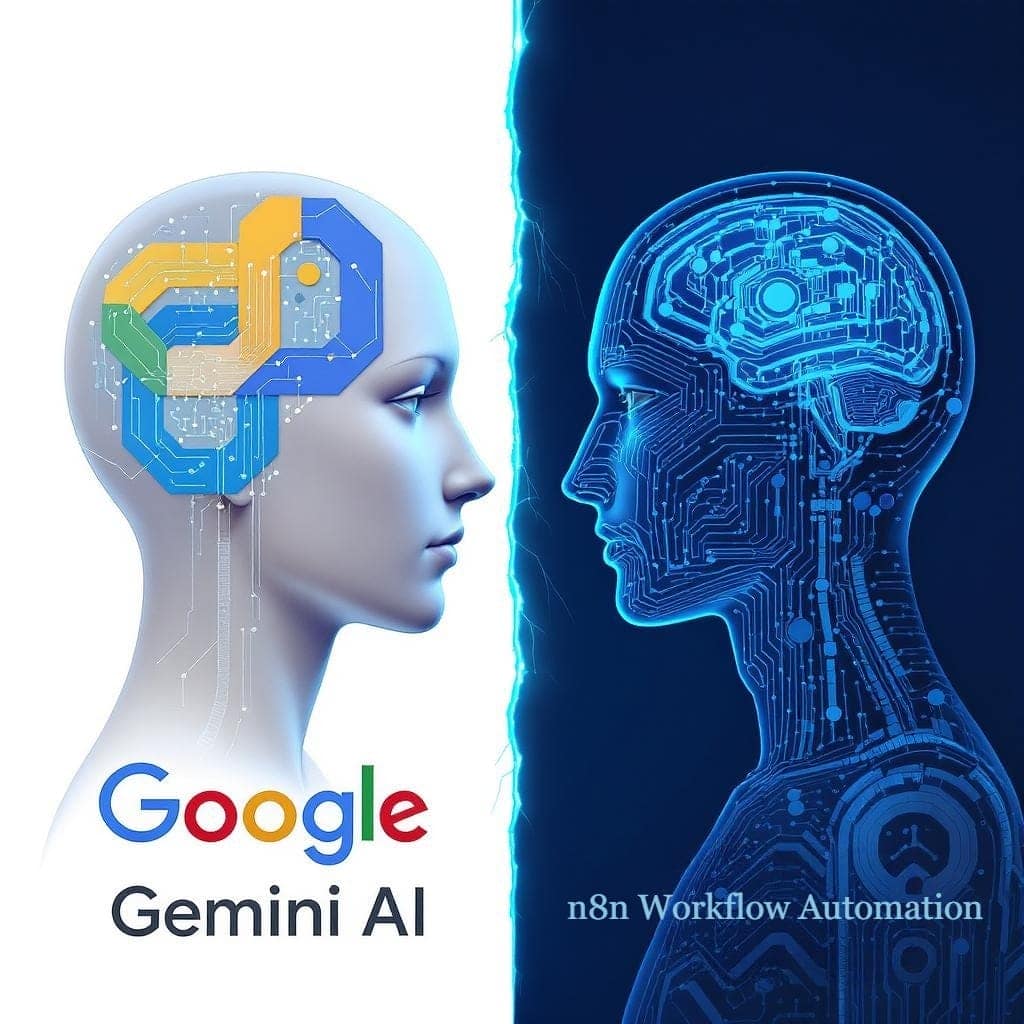
The AI Automation Revolution
In our fast-paced digital world today, organizations are investing more in using automation that drives efficiencies, reduces cost, and gets a competitive advantage. Google Gemini and n8n are two powerful platforms driving this revolution forward. While they approach automation in different ways, together, the two companies have the potential to fundamentally change how organizations utilize AI for workflow automation.
According to Mordor Intelligence, the global workflow automation market is experiencing explosive growth, projected to reach 23.77 billion by 2025 and expand to 23.77 billion by 2025 and expand to 23.77 billion by 2025 and expand to 37.45 billion by 2030, growing at a CAGR of 9.52%. This surge is driven by the increasing adoption of AI, IoT, and cloud technologies across industries, with 30% of enterprises expected to automate more than half their operations by 2026, as reported by Sharefile.
In this guide, we’ll explore how Google Gemini and n8n can be integrated to create powerful automations. We will also look at what Google Gemini and n8n are, how they can be set up, and how they can help your business.
Understanding Google Gemini: The AI Powerhouse
What is Google Gemini?
Google Gemini is the newest and most advanced family of AI models from Google (at the time of writing), designed to be natively multimodal – that is, to process and generate text, images, audio, video, and code. Gemini, which came out in December 2023 and was subsequently improved many times throughout 2024, is now an all-purpose AI with agentic capacities that continue to grow.
Key Capabilities of Gemini 2.0
The new Gemini 2.0 comes with a good number of features that make it good for automation.
- Gemini can work with different file types such as text, images, audio, and videos. This helps create more automation scenarios.
- Agentic Capabilities: Gemini 2.0 can understand more about the world, think multiple steps ahead, and take action on behalf of users (with supervision), making it ideal for complex workflow automation, as stated in this blog.
- Will you please paraphrase the following:
- Native Tool Use: The model can natively call tools like Google Search, code execution, and third-party user-defined functions, expanding its utility in automation workflows.
- Gemini 2.0 Flash can understand a long context with support for up to 1 million tokens.
- The improved reasoning abilities of Gemini can help it solve complex problems, follow complicated instructions, and create accurate outputs.
Gemini in Google Workspace
Google has integrated the powers of Gemini in Workspace apps to automate tasks.
- With AI at its heart, Google Flows is a new way to orchestrate and automate work. These flows can use Gems (custom AI agents built using Gemini) to handle specialized tasks, as found in this blog.
- Provide an analysis in the Sheets.
- In Google Meet, Gemini provides real-time summaries and updates for missed meetings if you come in late.
- In chat, Gemini can be added to conversations to help extract and summarize key points.
Understanding n8n: The Workflow Automation Platform
What is n8n?
n8n is an open-source workflow automation software that lets you connect any web services through a very intuitive, node-based interface. This stands apart for its innovation, flexibility, pleasant user experience, and other factors.
Key Features of n8n.
- n8n makes it easy to build workflows using its node-based interface, even if you don’t know how to code.
- n8n offers support for more than 400 built-in integrations for various services, and you can connect to virtually any service that offers an API.
- Self-hosting option – n8n can be self-hosted, unlike other competitors. It allows organizations to have control over the data and infrastructure.
- JavaScript or TypeScript support allows for the execution of custom code, enabling complex transformations.
- AI Agent Nodes: n8n has ready-to-go nodes for AI. These include specific nodes for Google Gemini, OpenAI, and every other AI.
n8n’s Pricing Model Advantage
n8n pricing works out at a per-workflow execution, as opposed to a per-operation basis, which makes it much cheaper for complex multi-step workflows, which usually involve AI automation. This contrasts with competitors like Make (formerly Integromat), which charges per operation, potentially leading to much higher costs for sophisticated automations.
Setting Up Google Gemini for Automation
Getting Started with Gemini API
You’ll need to integrate Gemini into your automation workflows.
- Create a Google AI Studio Account: Visit Google AI Studio and sign up or sign in with your Google account.
- Go to api keys and create an API key. This key allows you to authenticate requests to the Gemini API.
- Select the model that catches your attention. Do not select the model that you don’t like.
- Gemini 2.0 Flash: Fast and energetic.
- Gemini 2.0 Pro: Performers with balanced capabilities.
- The Gemini 2.0 Ultra is the highest capability model.
- Be conscious of your limits when automating coding to have a smoother experience, without unnecessary lag.
Key Gemini API Features for Automation.
When creating automations with Gemini, you will use these features a lot.
- Gemini is an LLM offering a function that calls based on what a user has input. In other words, you can use it to perform actions in your workflows.
- You can ask for responses in a structured way, such as JSON. This makes it more convenient for you to parse the output and use it in further automated steps.
- The instructions in the system allow it to generate the same result every time.
- Adjust the content filtering so that it filters out inappropriate content that is not appropriate.
Setting Up n8n for Workflow Automation
Installation Options
n8n has many ways to install it for different uses.
- n8n Cloud is the easiest option with no technical setup necessary. Plans start at €20 per month for 2,500 workflow executions.
- Self-Hosted Options:.
- In the Docker call, we create a clean environment and only require the database libraries.
- npm: Rapid initiation for local project development.
- Desktop software program for Windows, Mac, and Linux
Creating Your First n8n Workflow
To create a basic workflow in n8n.
- Access the n8n Dashboard: Go to your n8n instance.
- Begin by clicking on Create New Workflow and assigning a name that describes your workflow.
- Every workflow starts with a trigger when it is initiated, such as a webhook, scheduled event, or change in the database.
- Attach another node to process your data, make an API call, or perform any action you want.
- Test It and Then Turn It On. Utilize the testing features provided to verify that the workflow works, and then turn it on for production use.
Essential n8n Concepts for AI Integration
When working with AI in n8n, understand these key concepts.
- The building blocks of workflows are the nodes. These are actions, triggers, or transformations.
- Links between the nodes that define how the data moves through the workflow.
- Expressions: These are dynamic values that can use data from previous nodes or perform calculations.
- Credentials: Authentication information securely stored to connect to an external service.
- Error Handling: Set how your workflow should act when something goes wrong.
Integrating Google Gemini with n8n

Using the Gemini Node in n8n
Google’s Gemini node is a dedicated node for n8n.
- Find the Gemini Node in nodes, and add this to your flow. Search for Google Gemini in the nodes panel.
- Configure Authentication: Fill in your Gemini API key within the credentials section.
- Choose from operations like Chat Completion or Generate Content.
- Configure the model parameters, like temperature, top_k, and max output tokens.
- Link the Gemini node to the input of the previous node and the output of the subsequent node.
Example: Basic Text Generation Workflow
Here’s a simple workflow to generate content with Gemini.
- Webhook trigger allows you to create an entry point.
- Prepare the prompt and parameters for Gemini with a Function Node.
- Three, a Gemini node generates content based on input
- Send back to the caller: Send back the generated content.
By adding preprocessing, post-processing, or branching logic, Use Cases can be extended in a basic pattern.
Advanced Integration: Multi-Agent Systems
You can use n8n and Gemini to build multi-agent AI systems as one of the most强大的用法。
- Orchestrator Agent: This is a Gemini instance that will control the overall flow.
- Multiple Gemini instances are able to perform tasks like research, analysis, and content development.
- Memory Management: Use database nodes to maintain context between agent interactions.
- Device Interconnection – Take the integration of n8n with external agents and data sources.
This approach allows for sophisticated workflows where agents collaborate to solve complex problems, similar to the multi-agent architecture described in the DataCouch article.
Real-World Use Cases and Implementation
1. Automated Customer Support System
Challenge. Handling large quantities of customer inquiries across channels.
Solution. A Gemini-powered n8n workflow that.
- Looks at email, chat, and social media channels for new inquiries.
- Utilizes Gemini to organize and prioritize requests.
- Automatically answers common inquiries.
- Directs complicated matters to the right human resources.
- It stores the conversation log in a database to help provide context.
Implementation Steps.
- Set up trigger nodes for each communication channel.
- Use Gemini to analyze and categorize incoming messages.
- Create decision branches based on message type.
- Generate appropriate responses for automatable inquiries.
- Update CRM records and notify human agents when necessary.
2. Content Marketing Automation
Challenge. Making high-quality content consistently and distributing it widely.
Solution. An integrated workflow that.
- Creates concepts from trending topics and keywords.
- Making draft social media posts, articles, and email newsletters.
- Creates pictures and graphics that go along.
- Publish a schedule across several sites.
- Performance is analyzed and improvements suggested.
Implementation Steps.
- Use HTTP Request nodes to gather trending topics from various sources.
- Employ Gemini to generate content outlines and drafts.
- Create images using Gemini’s image generation capabilities.
- Connect to publishing platforms via their respective n8n nodes.
- Set up analytics tracking and feedback loops.
3. Data Analysis and Reporting
Challenge. Extracting insights from complex business data and effectively communicating them.
Solution. A workflow that.
- It connects to various data sources from databases, spreadsheets, to APIs.
- Cleans and preprocesses data.
- Uses Gemini to review trends and provide insights.
- Makes reports with visuals.
- Distribute the report to stakeholders through their channels.
Implementation Steps.
- Configure database nodes to extract relevant data.
- Use Function nodes for data cleaning and transformation.
- Process data with Gemini to identify patterns and insights.
- Generate reports with charts and explanations.
- Distribute via email, Slack, or other communication channels.
4. Social Media Monitoring and Engagement
Challenge. Staying active on social platforms and responding to mentions and trends at the right time.
Solution. An automated system that.
- Tracks the names of brands and related hashtags.
- Reviews posts for sentiment and urgency.
- Provides suitable responses for approval.
- Catches various trending topics relevant to the brand.
- Generates content options by means of social listening.
Implementation Steps.
- Set up social media trigger nodes for each platform.
- Use Gemini to analyze post content and sentiment.
- Generate response drafts for human approval.
- Identify and categorize trending topics.
- Create content suggestions based on social media activity.
5. Personalized Email Marketing
Challenge. Crafting personalized email campaigns that resonate with various customer segments.
Solution. A workflow that.
- Classifies customers by their behavior and preference.
- Creates customized email material for every segment.
- Subject lines that motivate email opens.
- Schedule emails for when your prospects respond.
- Look at what works and adjust for next time.
Implementation Steps.
- Connect to CRM or customer database to retrieve customer data.
- Use Gemini to analyze customer segments and preferences.
- Generate personalized email content for each segment.
- Connect to email marketing platforms for delivery.
- Track performance metrics and feed them back into the system.
Performance Comparison: Gemini vs. Other AI Models in n8n
Token Processing and Context Window
Using the context window of 1 million tokens of the Gemini 2.0 Flash is better than other models when it comes to complex instructions or large data sets. As demonstrated in a YouTube comparison, while OpenAI’s GPT-3.5 reached its token limit and failed when processing multiple database tables, Gemini 2.0 Flash successfully processed the entire dataset using only a fraction of its available context window.
This ability is handy for workflows that entail.
- Large document processing.
- Comprehensive data analysis.
- Complex multi-step instructions.
- Maintaining an extensive conversation history.
Cost Efficiency
Gemini is priced competitively compared to alternatives like OpenAI’s GPT, especially for automation workflows with high volume. The pricing model of Gemini alongside n8n’s execution-based (not operation-based) billing makes automations that are more complex cheaper.
Integration Capabilities
Both Gemini and other models provide an API, including GPT-4. However, Gemini has the added benefit of automatic integration with Google Workspace, making it superior for organizations that already use Google. This integration allows for automation across Gmail, Google Docs, Sheets, and other Workspace apps.
Best Practices for Google Gemini and n8n Integration
Optimizing Gemini Prompts for Automation
- Offer detailed instructions on what you want, along with a sample of the output that meets your request.
- Write the statement in your own words:
- Use System Instructions: Set consistent behavior guidelines for the model.
- Ask for a structure that can be parsed easily in a machine-readable format like JSON.
- Add a few examples of what the input/output should be.
- Modify the generation parameters like temperature, top_k, etc., according to the requirements of the task.
n8n Workflow Optimization
- Design in Modular Way: Complex workflows are broken down into small processes and reusable components.
- Error Handling: Create an error handling mechanism so it is reliable.
- Be careful not to hit the limit on the API; implement delays accordingly.
- Use caching so that you are not calling the API repeatedly.
- Be sure to test workflows with various inputs to ensure they work.
Security and Compliance Considerations
- Be careful of the data you send to external AI services.
- Securely store and manage API credentials.
- Implement suitable access controls for critical workflows.
- Keep logs of workflow executions for compliance
- Make use of the safety technology settings by Gemini to avoid getting unsafe outputs.
Future Trends: The Evolution of AI Automation
Emerging Capabilities
The joining of Google Gemini and n8n is only the very beginning of what’s happening with more powerful AI automation. Future developments are likely to include.
- AI systems that operate without much help from a person.
- Automation that operates with text, images, audio, and video in a seamless workflow.
- Systems that advance with time based on input and performance metrics.
- You can create and change workflows through a conversation.
- Cross-Platform Orchestration: Smooth synchronization between many platforms, services, and settings.
Industry-Specific Applications
Different areas will use the power of AI in their way.
- AI can be used for automated patient triage and treatment recommendation workflows.
- Fraud detection system, Risk assessment system, Personalized finance advice system.
- Manufacturing includes predictive maintenance, quality control, and logistics optimisation.
- Retail: Stock control, custom advertising, and tech-based buyer help.
- Document examination, contract assessment, and compliance verification processes.
Workflow Automation Market Growth Prediction 2023-2030 Source: Mordor Intelligence*.
Market Analysis: The Business Impact of AI Automation
ROI and Business Benefits
Firms utilizing AI to automate their workflow see big returns.
- Cost Reduction: Sharefile claims that automated workflows can reduce operational costs by 40-75%, particularly in data-intensive processes.
- Time Savings: Workers can regain 30% of their time that was once spent on repetitive functions.
- Automated processes typically have 37% to 90% less error rate than their manual counterparts.
- AI Workflows don’t require higher spending as the volume increases, making it scalable.
- Employee Satisfaction: Vena Solutions blog claims that 88% of workers using automation report higher job satisfaction due to reduced drudgery.
Competitive Landscape
The automation market has large players
- n8n is designed to be flexible, developer-friendly, and self-hosted.
- The platform is easy to use and has many integrations.
- Make (previously known as Integromat) helps you design workflows in a visual manner for automation and integration that’s especially strong at handling complex logical conditions and flows.
- Microsoft Power Automate fully integrates with the Microsoft system.
- Tray.io: For organizations that want to automate more complex processes.
n8n differs.


